Click image for BBB rating
See our Privacy Policy
cool="cool" width="866" height="8707" border="0" cellpadding="0" cellspacing="0" gridx="16" showgridx="showgridx" usegridx="usegridx" gridy="16" showgridy="showgridy" usegridy="usegridy" bgcolor="#99ccff">
|
 |
|
|
|
|
|
|
Welcome to Spaightwood Galleries, Inc.
120 Main Street, Upton MA 01568-6193
You can follow us on Facebook and Twitter!
We blog regularly on Facebook and announce special events and special sales on both sites.
Old Master Drawings: Paolo Cagliari called Veronese (c. 1528-1588)
|
|
|
|
Titian, Veronese, and Jacopo Tintoretto dominated the Venetian art scene for most of the 16th century, winning most of the public and religious commissions during that period. The Doges' Palace in Venice is particularly rich in work by Veronese. Veronese's studio was active and works from it were eagerly sought. Sir Philip Sidney, the English poet, diplomat, and soldier, after fleeing the St. Bartholomew Day's massacre in Paris in 1572 went to be mentored by Hubert Languet at the Emperor's Court. Several years later, wanting to commission a portrait for Languet before he went back to Engliand, he went to Venice, where, after visiting the studios of both Veronese and Tintoretto, he commissioned his portrait from Veronese. Veronese was also popular with the nobility, who commissioned works for their villas and studies, often of an allegorical nature.
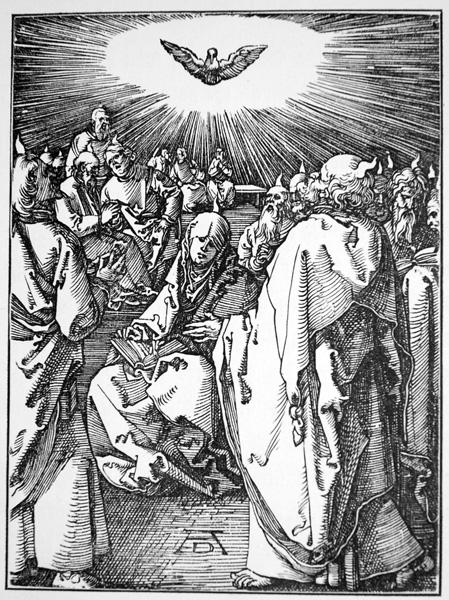
In his introduction to W. R. Rearick, The Art of Paolo Veronese 1528-1588 (Washington DC: National Gallery of Art, 1988), Teresio Pignatti observes that one of the ways in which Veronese differs from his contemporaries is "his exceptional virtuosity in drawing," which was based "not only on direct acquaintance with the paintings to be seen in Mantua and Parma, but also on his familiarity with drawings and engravings by or after Parmigianino and his Venetian followers such as Schiavone" (p. 6). According to Pignatti, early critics of Veronese, starting with Vasari, stressed Veronese's graphic skill as "an essential aspect of an artist they viewed almost as repudiating the reigning principle in Venice, color." Pignatti notes that in 1556 Francisco Sansovino, the first critic to describe the paintings in the Sala del Consiglio dei Dieci in the Palazzo Ducale, affirmed that " 'Paolo is beginning to make himself known as something rare in his profession' and that his work proves him 'truly possessed of disegno [design, drawing]] and delicacy.' " Pignatti also reminds us that Ridolfi's mid-17th century study of Veronese stresses that Veronese "used to train his hand by copying Durer's engravings and prints, and perhaps as well certain drawings by Parmigianino that he found in an album owned by the Muselli family in Verona" (p. 6). We may observe this in the drawing after Durer's Pentecost in his Small Woodcut Passion below.
Select Bibliography: Art Gallery of Toronto, Titian, Tintoretto, Paolo Veronese with a group of sixteenth-century Venetian drawings (Toronto: Art Gallery of Toronto, 1960; Richard Cocke, Veronese Drawings. A catalogue raisonne (London: Sotheby Publications, 1984); Charles Hope, Veronese and the Venetian Tradition of Allegory (London: The British Academy, 1986); Ilchman, Frederick et al. Titian, Tintoretto, Veronese: Rivals in Renaissance Venice (Boston: MFA, 2009); Remigio Marini, L'opera completa del Veronese, Classici dell'Arte 20 (Milano: Rizzoli, 1968); Antoine Orliac, Veronese (Paris: Hyperion Press, 1940); Terisio Pignatti and Filippo Pedrocco, Veronese Catalogo completo (Milano: Electa, 1991); Terisio Pignatti and Filippo Pedrocco, Veronese 2 vols. (Milano: Electa, 1995); W. R. Rearick, The Art of Paolo Veronese 1528-1588 [Washington DC: National Gallery of Art, 1988); Giandomenico Romanelli et al, Veronese: Gods, Heroes and Allegories (Milan: Skira, 2004); David Rosand, Painting in Sixteenth-Century Venice : Titian, Veronese, Tintoretto (Cambridge: Cambridge University Press, 1997); David Rosand, Veronese & His Studio in North American Collections (Birmingham Museum of Art & Montgomery Museum of Fine Arts, 1972); Veronese e Verona (Verona: Museo di Castelvecchio, 1988); Veronese. Une Dame Venitienne dite la Belle Nani (Paris: Musee du Louvre, 1996); Bruno Visentini, ed. texts by Alessandro Bettagno, W. R. Rearick, Staale Sinding-Larsen, and Lionello Puppi, Paolo Veronese. Disegni e dipinti. Grafica Veneta 5 (Vicenza: Neri Pozza Editore, 1988); Peter Watson, Wisdom and Strength: The Biography of a Renaissance Masterpiece (NY: Doubleday & Co. New York, 1989).
|
|
|
 |
|
|
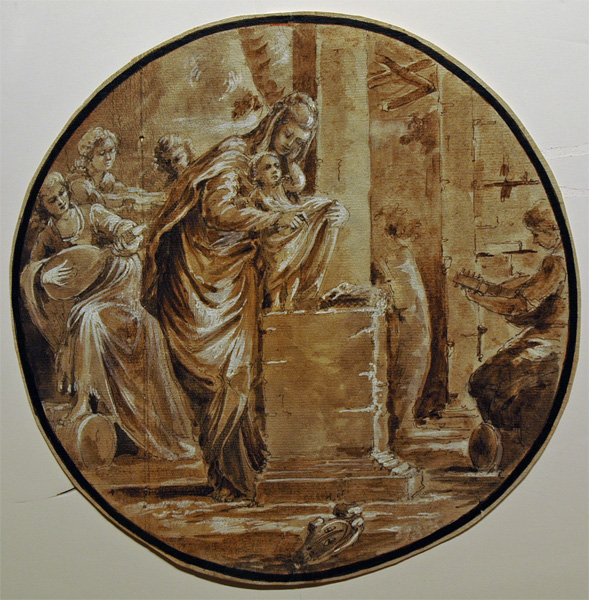
Our drawing is a variant of a drawing in the Louvre by "Paolo Cagliari called Veronese (c. 1528-1588)," titled "Pittura Quarta," and otherwise titled variously Virgin and Child with Musical Angels in the Wilderness (Richard Cocke, Veronese Drawings. A catalogue raisonne [London: Sotheby Publications, 1984], n. 19, p. 76) or The Madonna as a Seamstress (W. R. Rearick, The Art of Paolo Veronese 1528-1588 (Washington DC: National Gallery of Art, 1988), illustrated frontispiece and pp. 164-65. Brown wash base with pen and brown ink and heightening in white body color. Our drawing is on cream laid paper with a watermark close to Briquet 7112 (Salerno 1570) and 7113 (Ferrarra 1570) and a worn collector's mark on verso.
The Louvre's variant, "Pittura Quarta," depicts the Virgin and Child surrounded by six angels in a rectangular format. The Virgin holds what Cocke describes as a "strange implement (a Pair of tongs?)" while Jesus reaches up to caress her face. On the left side, three musical angels in similar positions in a similar arrangement are serenading them; on the right, three more angels play for her, one of whom, seated playing a lute is close to ours, the only one on the right side of our drawing. In the background are the ruins of a building (perhaps the manger). Cocke dates the "splendid series of finished chiaroscuro drawings catalogued together (numbers 17-42) as independent works produced in the 1550s and early 1560s" [p. 21]). Rearick dates it 1583-84 and reproduces it as the frontispiece of The Art of Paolo Veronese 1528-1588 in a full-page illustration and discusses again on pages 164-65 with a smaller illustration. Our drawing is circular, the Louvre's is rectangular. Both are beautiful and well-executed drawings, ours, perhaps a presentation drawing, seems more brilliant, finished and assured. According to Cocke (p. 77, note 7), the Louvre's Veronese remained in Veronese's studio during the artist's lifetime: "That it remained in the studio may be confirmed by the painting in the collection of Antonio Zecchini in Pescara, which measured about the same size as the drawing and was, to judge from the engraving by Diogini Valesi, a studio derivation from the drawing." Our Veronese shows precisely the characteristics that Cock praises: "independent works in preparatory drawings and executed with a brilliance and fluidity in the white heightening that was copied but never equalled." Rearick identifies the "strange implement" as a pair of shears, with which the Virgin is trimming Jesus' garment. This makes sense of the little basket sitting next to Jesus' feet as her sewing basket. His arguments for the later date can be found on p. 165. Rearick's later date finds at least some support in Annalisa Scarpi's remarks on a drawing in pen and brown ink with white lead heigtening that Veronese prepared in connection with his Triumph of Venice for the ceiling of the Sala del Maggior Consiglio above the Doge's throne commissioned 1579 and completed by 1582 (see Giandomenico Romanelli et al, Veronese: Gods, Heroes and Allegories [Milan: Skira, 2004], p. 140; see also p. 142, where Scarpi dates another of the chiaroscuro drawings, The Triumph of Fame over Evil to the 1580s).
Cocke's comments on these chiaroscuro drawings are useful: "The independent chiaroscuro drawings were among the most admired of Veronese's drawings, being the only ones mentioned by his first biographer Ridolfi in 1648. Ridolfi's enthusiasm is understandable, for they were planned as independent works in preparatory drawings and executed with a brilliance and fluidity in the white heightening that was copied but never equaled. Veronese here turned to an older tradition of Venetian drawing with a sense of invention in conventional subjects, both religious and allegorical and in unusal variations on well-established themes (p. 71). If Rearick is correct in his dating and the date of ours is close to the year in which the paper was manufactured, ours is either a variant of another drawing of the scene not yet published or it is the original version of the Louvre's drawing.
One of Veronese's small ink drawings sold at auction at Christie's London on Dec. 5, 2006 for £180,000 (then Please call or email for current pricing information). We offer ours for a bit less than that price. Image size: 285mm diameter. Price: Please call or email for current pricing information.
|
|
|
|
 |
|
|
|
Paolo Veronese (attributed), Juno and her peacock on a cloud seen from the rear. Brush and brown ink and wash on laid paper, c. 1570. Titian, Paolo Veronese, and Jacopo Tintoretto dominated the Venetian art scene for most of the 16th century, winning most of the public and religious commissions during that period. The Doges' Palace is particularly rich in work by Veronese. Hope, in Veronese and the Venetian Tradition of Allegory, talks about the distinct meanings of Juno in Venetian ceiling paintings in the 1560s-1580: Juno as Venice's patron (see pp. 409, 410); Juno as the element of air (Hope, pp. 415, 416), and Juno as one of the patrons of marriage (Hope, 419 and plate xxvii [b]). See also Pignatti and Pedrocco 1991, p. 111 (Juno clothed on a cloud with her peacock and a putto); p. 130: Juno, Hymen and Venus on a cloud in the Stanza dell'amor coniugale (in the Villa Barbaro at Maser, c. 1561-62?); p. 224, fig. 143d, Juno and Apollo in the Fontego dei Tedeschi in Venice; p. 230, pl. 149b, where the central figure in Infedeltà [Infidelity] (c. 1576-78) is a half-naked female figure seen from behind and below who shares much of the physicality of our drawing; p. 263, pl. 190, The Trionfo di Venezia in the Salo del Maggior Consilio in the Palazzo Ducale in Venice (1579-1582), in which the enthroned figure of Venice is attended by a number of figures, including a crowned female nude seated on a cloud seen from behind and below. See below for another drawing on the verso with an unidentified collector's mark. Image size: 262x188mm. Price: Please call or email for current pricing information.
|
|
|
|
|
|
 |
|
|
|
 |
|
A man kneeling by a large urn. Brush and brown ink and wash over pencil on cream laid paper. Image size: 137x190mm.
|
|
|
 |
|
 |
|
|
|
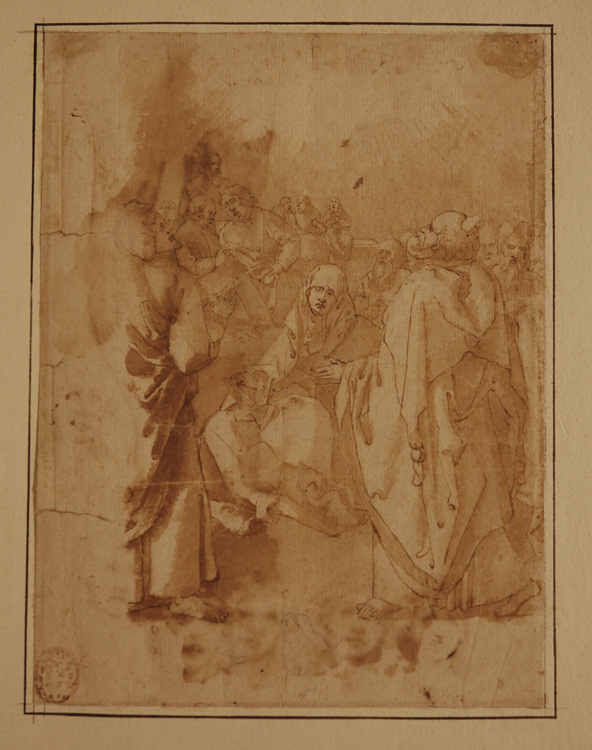
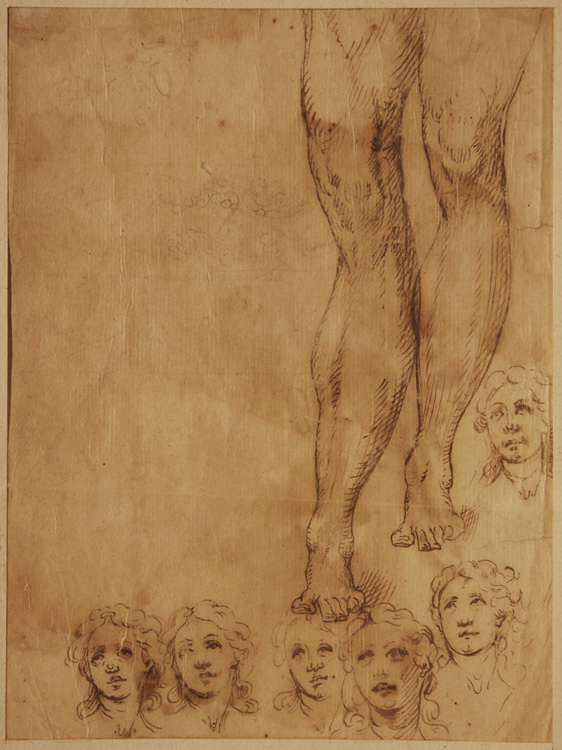
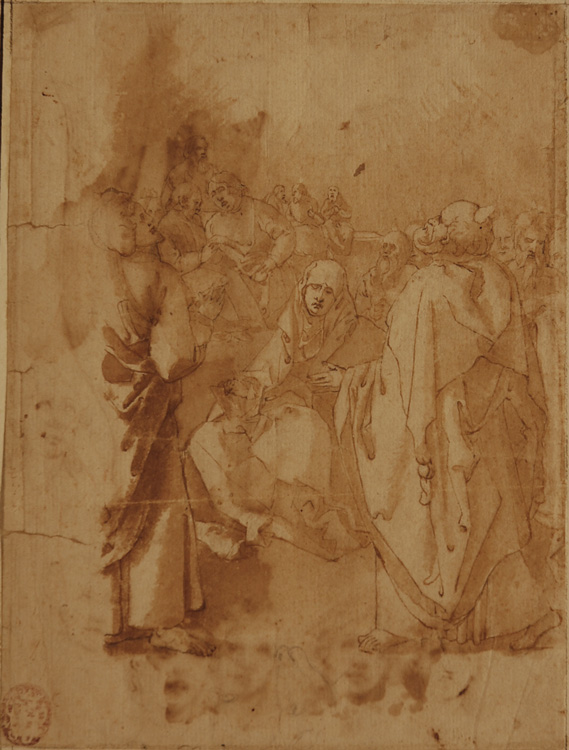
Paolo Veronese, attributed, Pentecost. Pen and brown ink and wash on cream laid paper, c. 1545-55?. Old collector's mark lower left. On the verso are 6 studies of heads looking upwards and a study of feet and legs, possibly a study for a crucifixion. The heads show through on the left side and the bottom of this sheet. If one compares this drawing with Durer's Pentecost in the Small Woodcut Passion, it is clear that Veronese was working with it close at hand. Image size: 215x165mm. Price: Please call or email for current pricing information.
|
|
VERSO: Paolo Veronese, attributed, Studies for a Crucifxion?. Pen and brown ink and wash on cream laid paper, c. 1545-55?. Old collector's mark verso lower left. On the verso is a study of Durer's Pentecost from the Small Woodcut Passion showing the Virgin and the Apostles receiving the Holy Spirit on Pentecost. Image size: 215x165mm.
|
|
|
|
|
 |
|
|
|
 |
|
|
|
|
|
|
|
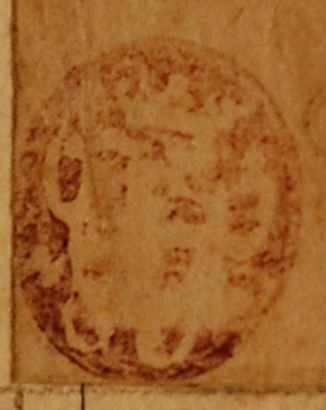
Collector's stamp, lower left. While indistinct, the seal appears to feature a crown top center, possibly suggesting that it was once in a ducal, princely, or royal collection.
|
|
|
 |
|
|
|
Albrecht Durer (Nuremburg, 1471-1528), Pentecost (Bartsch 51, Strauss 135) Original woodcut, c. 1510 for the Small Passion. In 1844 plaster casts were made from Durer's original woodblocks for the Small Woodcut Passion, which had just been acquired by the British Museum. From these casts, metal plates were made and a small edition produced. Our impression is from this edition. Veronese used this woodcut as a model for his drawing of the Pentecost (see immediately above). Image size: 123x95mm. Price: Please call or email for current pricing information.
|
|
|
|
|
|
 |
|
|
|
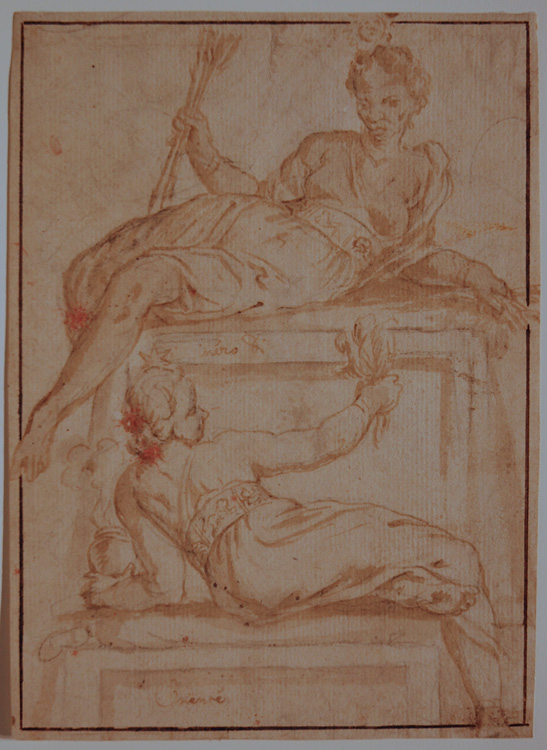
Veronese School (Venice, late 16th-early 17th century) Allegorical figures of Africa and Asia. Brush and brown ink and wash and black chalk on cream laid paper, c. 1600. With contemporary inscriptions in ink. Titian, Paolo Veronese, and Jacopo Tintoretto dominated the Venetian art scene for most of the 16th century, winning most of the public and religious commissions during that period. The Doges' Palace is particularly rich in work by Veronese. This particular piece could have served as part of a representation of Venice's power of the peoples of the various continents because of her role as Queen of the Seas. Image size: 262x188mm. Price: Please call or email for current pricing information.
|
|
|
|
|
|
 |
|
|
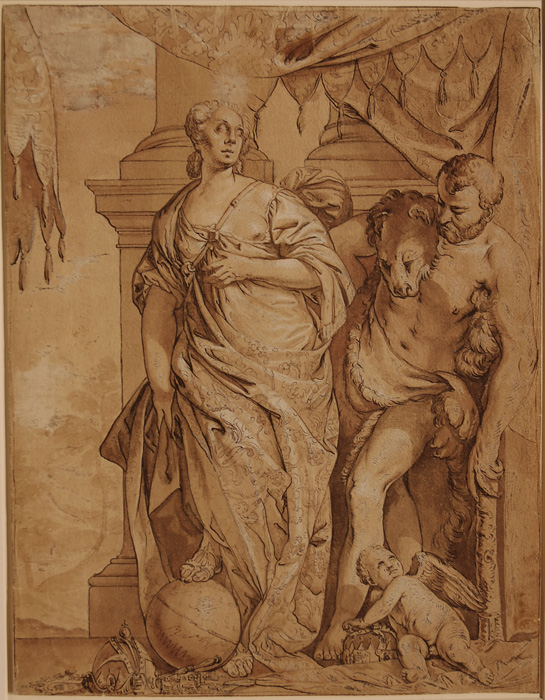
Allegory of Wisdom and Strength. Pen and black ink and brown wash with white heightening. This is a drawing after Veronese's painting of the same name, which was in the collection of the Holy Roman Emperor Rudolf II at the end of the 16th-century and later in the Collection of Queen Christiana of Sweden, who invaded in 1649 after the 30 Years war and looted the Imperial Collection in Prague. The painting is now in the Frick Collection in New York City. For an extended study of Veronese's painting, see Peter Watson, Wisdom and Strength: The Biography of a Renaissance Masterpiece (NY: Doubleday, 1989).This drawing is likely to be fairly contemporaneous with the painting; one of the ways that artists studied other artist's solutions to artistic problems was to make drawings of the paintings or drawings they came across that they thought might offer them help with their own compositions. See, for instance, Jeremy Wood, Rubens: Drawing on Italy (Edinburgh: National Gallery of Scotland, 2002, for a study of how Rubens purchased Italian prints and drawings while he was in Italy and copied them, reworked them, enlarged them, and revised them over the next 30 or so years. Drawings were also a way of providing prospective buyers of works by international masters with an idea of what they might purchase. Image size: 357x275mm. Price: Please call or email for current pricing information.
|
|
|
|
|
|
 |
|
|
|
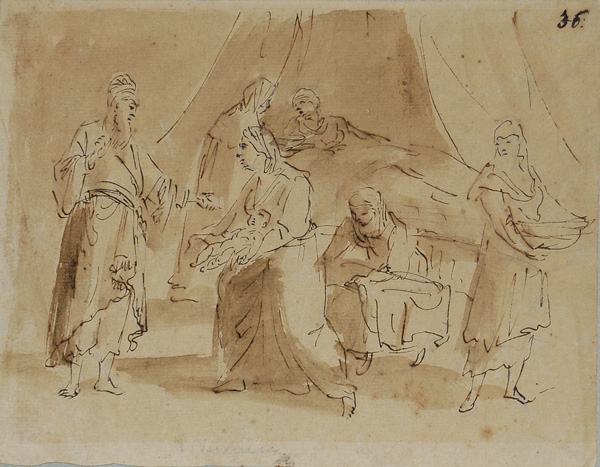
Paolo Cagliari called Veronese (c. 1528-1588), circle of, The Birth of the Virgin. Pen and brown ink on thin laid paper. This seems to have been in a collector's album of drawings at one point: it is numbered 36 in ink upper right and attributed to Veronese in pencil under the drawing left of center. In the background, St. Anne reclines in a canopied bed attended by a servant while others clean up after the birth. In the foreground, another servant shows the Virgin to Joachim. Image size: 155x200mm. Price: Please call or email for current pricing information.
|
|
|
|
 |
|
|
|
Italian School (Venice, mid 16th-century), The Adoration of the Magi. Pen and brown ink and wash on cream laid paper, c. 1550? A very beautiful drawing in poor condition: abrasions lower left, repaired paper loss on the left side above the head of the kneeling Magus and partially obscuring the heads of the other two Magi. The drawing has been restored amd mounted on an archival suport sheet. Image size: 253x180mm. Price: Please call or email for current pricing information.
|
|
|
|
|
|
Spaightwood Galleries, Inc.
To purchase, call us at 1-800-809-3343 (1-508-529-2511 in Upton MA & vicinity) or send an email to spaightwood@gmail.com.
We accept AmericanExpress, DiscoverCard, MasterCard, and Visa.
We also accept wire transfers and Paypal.
For directions and visiting information, please call. We are, of course, always available over the web and by telephone (see above for contact information). Click the following for links to past shows and artists. For a visual tour of the gallery, please click here. For information about Andy Weiner and Sonja Hansard-Weiner, please click here. For a list of special offers currently available, see Specials.
All works are sold with an unconditional guarantee of authenticity (as described in our website listing).
Go back to the top of this page.
Visiting hours: Saturday 10:00 am to 5:00 pm and Sunday noon to 6:00 pm and other times by arrangement.
Please call to confirm your visit. Browsers and guests are welcome.
|
|
|
|
|
|
|
|
|
|
|
|
|
|
|
|
|
|
|
|
|
|
|
|
|
|
|
|
|
|
|
|
|
|
|
|
|
|
|
|
|
|
|
|
|
|
|
|
|
|
|
|

