|
Welcome to Spaightwood Galleries, Inc.
120 Main Street, Upton MA 01568-6193
You can follow us on Facebook and Twitter!
We blog regularly on Facebook and announce special events and special sales on both sites.
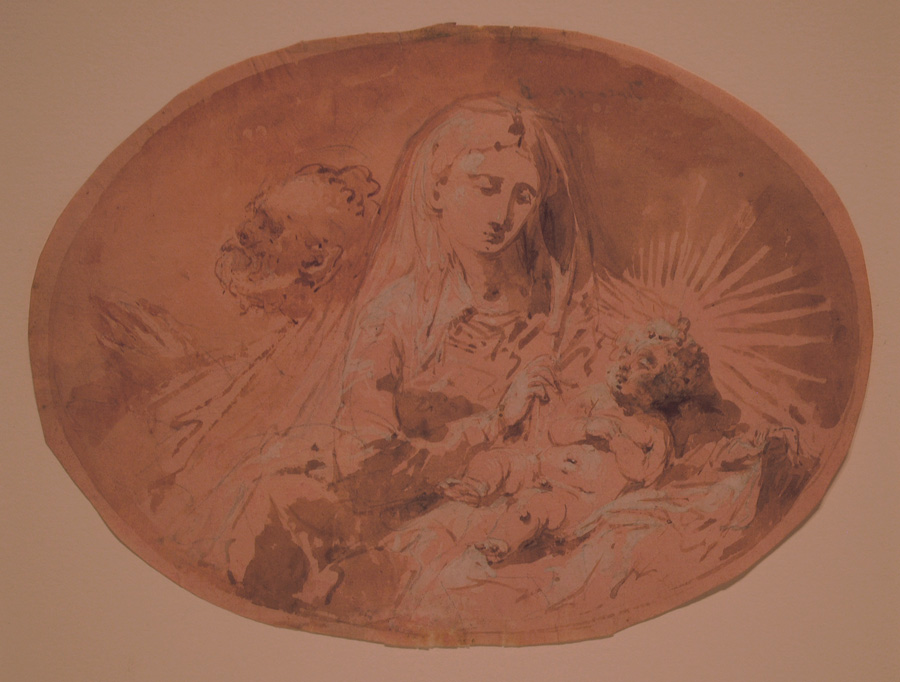
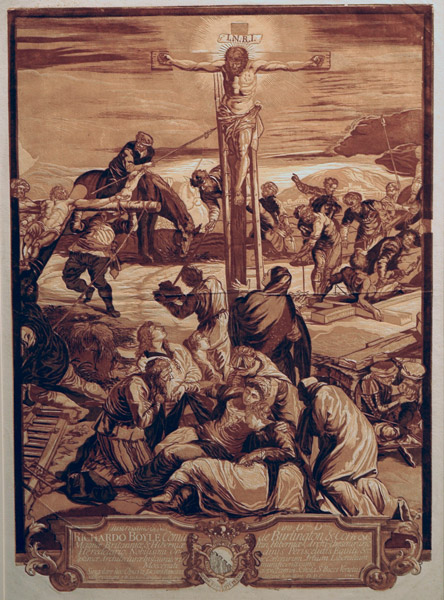
Old Master Drawings and Prints: Tintoretto (Jacoppo Robusti, Venice, 1518-1594)
|
|
|
|
Tintoretto had a sign in his workshop saying that here could be found "the drawing of Michelangelo and the color of Titian," and it is clearly Titian's color that most 16th-century viewers found overwhelming. Vasari, in his "Life of Titian" (in Part III of The Lives of the Painters, Sculptors, and Architects) reports that Sebastiano de Piombo remarked that "if Titian had gone to Rome and seen the works of Michelangelo, Raphael, and the ancient statues there, and had studied design ("disegno" in Italian combines the meanings of both "drawing" and "design"), he would have produced stupendous things, seeing his skill in coloring, in which he deserves to be called the best maser of our day for his imitation of natural tints; and with a foundation of great draughtmanship he would have overtaken the Urbinate [Raphael] and Buonarroto [Michelangelo] (Everyman edition, III: 200-201)." Vasari later confirms Sebastiano's judgment by telling of a visit that he and Michelangelo made to Titian's studio in Rome: "After they had gone, Buonarroti criticized Titian's methods, prasing him a good deal, and saying that he liked his coloring and style, but that it was a pity that good design was not taught at Venice from the first, and that her best painnters did not have a better method of study. If this man, he said, were aided by art and design as he is by Nature, especially in copying from life, he would not be surpassed, for he has ability and a charming and vivacious style" (Everyman edition, III: 206-207). Very few of Titian's drawings survive, partly because he worked in oil not fresco and drew directly on his canvases, but despite the criticism of his drawing or lack of it, Titian did not lack noble patrons including the Emperor Charles V, his son, Philip II, the King of Spain, various princes and dukes, popes and cardinals, and a lifetime worth of Venetian Doges. With such a widespread group of admireres, it is not surprising that engravers stepped forward to spread his fame by reproducing his most famous paintings and that woodcutter followed his example in his 1508 epic woodcut of The Triumph of the Faith, a work Vasari categorizes as "displaying vigor, style, and knowledge. The engravings and woodcut below reflect part of the widespread demand for works designed by Titian.
Selcted Bibliography: Roland Krischel, Masters of Italian Art: Jacopo Tintoretto 1519-1594 (Cologne: Konemann, 2000); Tom Nichols, Tintoretto: Tradition and Identity (London: Reaktion Books, 1999 [large- format paperback available for purchase new: Please call or email for current pricing information]); Carlo Ridolfi, The Life of Tintoretto and of his children Domenico and Marietta, trans. Catherine and Robert Enggass (University Park: Pennslyvania State University Press,1984); David Rosand, Painting in Cinquecento Venice: Titian, Veronese, Tintoretto (New Haven: Yale University Press, 1982); Cornelia Syre, ed., Tintoretto: The Gonzaga Cycle (Munich: Hatje Cantz,2000); Jacopo Robusti Tintoretto, La Mostra del Tintoretto (Venezia ca' Pesaro: 1937); Francesco Valcanover, Jacopo Tintoretto and the Scuola Grande of San Rocco (Venice) (Venice: Stoti Edizioni, 1999 [this is the guide book in English to Tintoretto's painting cycle available at the Scuola: large-format paperback available for purchase : Please call or email for current pricing information]); Henri Zerner et al, ed., The Illustrated Bartsch 32: Italian Masters of the 16th Century: Parmigianino, Master F.P., Meldolla, Schiavone, Titian, Marconi, Tintoretto, Bresciano, Franco, P. Farinati, H. Farinati, del Moro, Fontana, Valentinis (NY: Abaris Books,1979).
|
|
|
|
Spaightwood Galleries, Inc.
To purchase, call us at 1-800-809-3343 (1-508-529-2511 in Upton MA & vicinity) or send an email to spaightwood@gmail.com
We accept AmericanExpress, DiscoverCard, MasterCard, and Visa.
We also accept wire transfers and paypal.
For directions and visiting information, please call. We are, of course, always available over the web and by telephone (see above for contact information). Click the following for links to past shows and artists. For a visual tour of the gallery, please click here. For information about Andy Weiner and Sonja Hansard-Weiner, please click here. For a list of special offers currently available, see Specials.
t Coffin, please click ere.All works are sold with an unconditional guarantee of authenticity (as described in our website listing).
Copyright 2004-2017, Spaightwood Galleries, Inc.
Go back to the top of this page.
Visiting hours: Saturday 10:00 am to 5:00 pm and Sunday noon to 6:00 pm and other times by arrangement.
Please call to confirm your visit. Browsers and guests are welcome.
|
|
|