Click image for BBB rating
See our Privacy Policy
cool="cool" width="785" height="7417" border="0" cellpadding="0" cellspacing="0" gridx="16" showgridx="showgridx" usegridx="usegridx" gridy="16" showgridy="showgridy" usegridy="usegridy" bgcolor="#99ccff">
|
|
|
 |
|
|
|
|
|
|
Welcome to Spaightwood Galleries, Inc.
120 Main Street, Upton MA 01568-6193
You can follow us on Facebook and Twitter!
We blog regularly on Facebook and announce special events and special sales on both sites.
Jim Bird: Madison Series Mixed Media I—large
|
|
|
|
The Madison Series of mixed media works on paper combining monotype, acrylic paint, oil stick, pastel, and other media (spmetimes including melted crayons) sponsored by Galeria Joan Prats and Spaightwood Galleries, came about when the late Wayne Taylor, Professor of Art at the University of Wisconsin, Madison and the possessor of a large-bed printing press, met Bird at our first Madison showing of his works in 1982. They quickly became friends and the possibility of a project at Taylor's Stoughton WI studio became a reality in 1987, thanks to the enthusiasm of Dorothy Cater, Jim's wife and the director of Galeriea Joan Prat's New York office, for the project. Their collaboration produced an outpouring of works which pleased everyone concerned so much that they scheduled a repeat for 1988. Many of the works were shown (and sold) at Galeria Joan Prats NY, Galeria Joan Prats Barcelona, and several International Art Fairs at venues including the Chicago Navy Pier, Barcelona, Paris, and London; although we have also shown a number of these works in shows, most of the pieces on this page were on reserve in our own collection for many years and are offered here for the first time on our website.
Bird’s works frequently illustrate Motherwell’s insistence that sometimes the artist is privileged to be “an expresser of adoration for the miracle of a world that has colors, meaningful shapes, as spaces that may exhibit the real expansion of the human spirit as it moves and has its being.” Bird's works frequently depict what he calls “Landscapes of the Mind,” most often keyed to his memories and feelings about Spain, but all concerned with the space in which the human spirit creates to discover its freedom. As Bird said in a 1990 essay for a show at Galeria Joan Prats, his longtime dealer, "If one accepts the premise that art can be the mirror within which we may see ourselves, then the quest should be to get the glass true. The problem is that it never is quite true and the image we see is distorted, but, before dismissing one mirror for another, judgment should be suspended, as mostly the unconscious reach is greater than the conscious grasp. It is obvious that great art has its source at some point beyond conscious striving, and if this fount is to become accessible it requires an act of faith on the part of the artist to do “nothing” and to allow the dreaming and fantasizing, that least understood part of the creative endeavor, to take place, the space in which the wretchedness of the human condition is re-composed and put into an acceptable form."
Jim Bird's work has been shown at galleries and museums in Spain, England, Germany, and the U. S. (Barcelona, Madrid, London, New York, Chicago, Madison, and Palo Alto, among other sites); he has also been shown at the Basel Art Fair, the International Navy Pier Exposition in Chicago, and the International Print Biennale (England). Jim Bird was also in the news when The Journal of Art illustrated one of his monotypes (one of the Madison Series executed at Wayne Taylor’s studio and published by Spaightwood Galleries several years ago) in an essay entitled, “The Elusive Monotype: Painting or Print?” in the June-July-August 1991 issue. In 1994, his work was featured in the first issue of Graven Images: Studies in Culture, Law, and thee Sacred (published by the University of Wisconsin Law School), and one of his etchings was illustrated on the rear cover.
|
|
|
 |
|
|
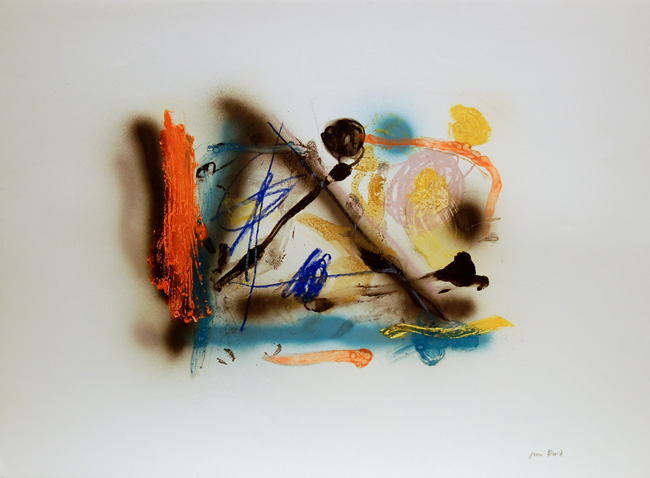
Jim Bird (England, 1937-2010 Spain), Madison Series 4. Mixed media, 1987. These works combine monotype, acrylic, oil stick, pastel, and other media. They might be best described as exploring the space between painting, drawing, and print-making. Image size: 574x768mm. Price: Please call or email for current pricing information.
|
|
|
|
|
 |
|
|
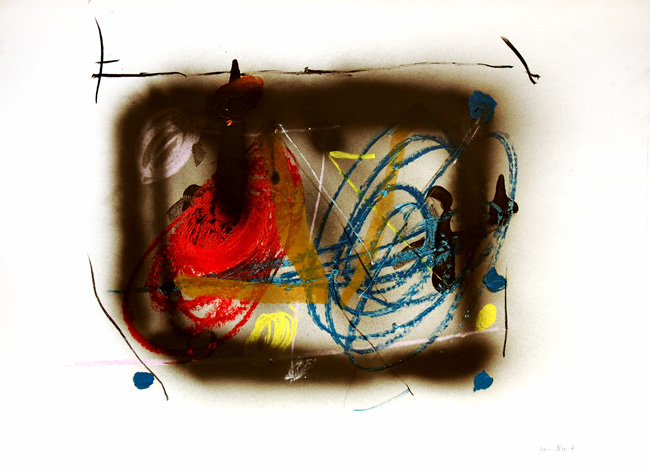
Jim Bird (England, 1937-2010 Spain), Madison Series 7. Mixed media, 1987. These works combine monotype, acrylic, oil stick, pastel, and other media. They might be best described as exploring the space between painting, drawing, and print-making. Image size: 574x768mm (22-5/8x30-1/4 inches). Price: Please call or email for current pricing information.
|
|
|
|
|
 |
|
|
Jim Bird (England, 1937-2010 Spain), Madison Series 17. Mixed media, 1987. These works combine monotype, acrylic, oil stick, pastel, and other media. They might be best described as exploring the space between painting, drawing, and print-making. Image size: 574x768mm. Price: Please call or email for current pricing information.
|
|
|
|
|
 |
|
|
Jim Bird (England, 1937-2010 Spain), Madison Series 18. Mixed media, 1987. These works combine monotype, acrylic, oil stick, pastel, melted crayon, and other media. They might be best described as exploring the space between painting, drawing, and print-making. Image size: 574x768mm. Price: Please call or email for current pricing information.
|
|
|
|
|
 |
|
|
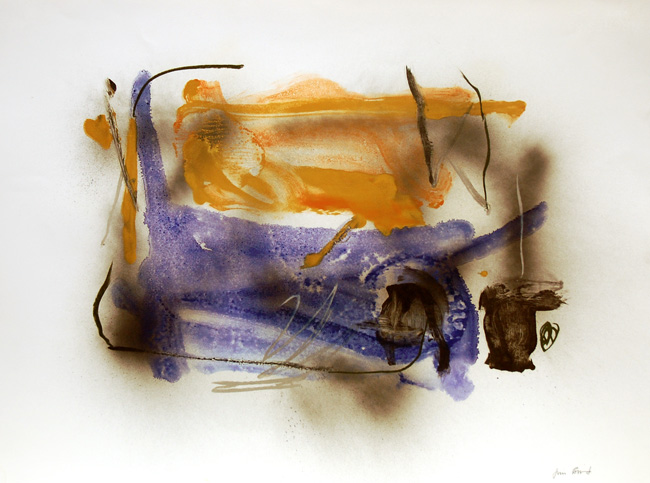
Jim Bird (England, 1937-2010 Spain), Madison Series 20. Mixed media, 1987. These works combine monotype, acrylic, oil stick, pastel, and other media. They might be best described as exploring the space between painting, drawing, and print-making. Image size: 574x768mm. Price: Please call or email for current pricing information.
|
|
|
|
|
 |
|
|
Jim Bird (England, 1937-2010 Spain), Madison Series 29. Mixed media, 1987. These works combine monotype, acrylic, oil stick, pastel, and other media. They might be best described as exploring the space between painting, drawing, and print-making. Image size: 574x768mm. Price: Please call or email for current pricing information.
|
|
|
|
|
 |
|
|
Jim Bird (England, 1937-2010 Spain), Madison Series 30. Mixed media, 1987. These works combine monotype, acrylic, oil stick, pastel, and other media. They might be best described as exploring the space between painting, drawing, and print-making. Image size: 574x768mm. Price: Please call or email for current pricing information.
|
|
|
|
|
 |
|
|
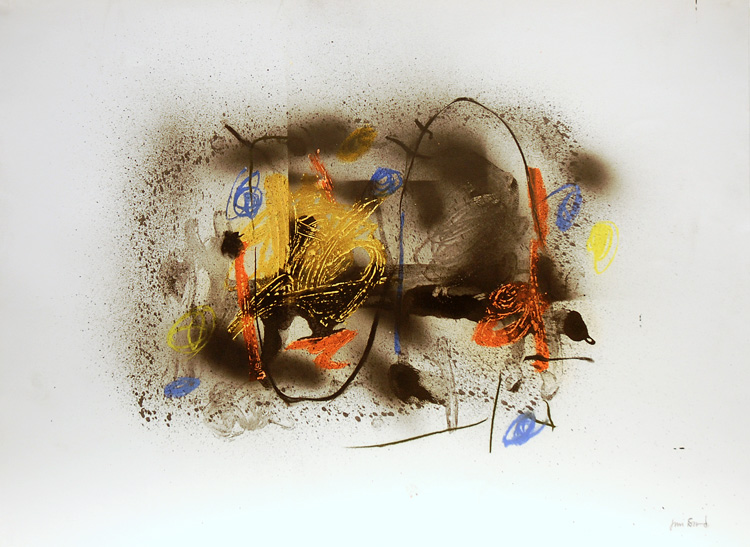
Jim Bird (England, 1937-2010 Spain), Madison Series 32. Mixed media, 1987. These works combine monotype, acrylic, oil stick, pastel, and other media. They might be best described as exploring the space between painting, drawing, and print-making. Image size: 574x768mm. Price: Please call or email for current pricing information.
|
|
|
|
|
 |
|
|
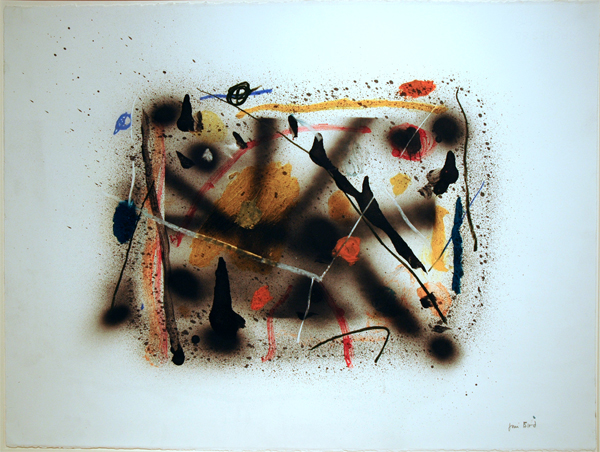
Jim Bird (England, 1937-2010 Spain), Madison Series 34. Mixed media, 1987. These works combine monotype, acrylic, oil stick, pastel, and other media. They might be best described as exploring the space between painting, drawing, and print-making. Image size: 574x768mm. Price: Please call or email for current pricing information.
|
|
|
|
|
 |
|
|
Jim Bird (England, 1937-2010 Spain), Madison Series 28. Mixed media, 1987. These works combine monotype, acrylic, oil stick, pastel, and other media. They might be best described as exploring the space between painting, drawing, and print-making. Image size: 574x768mm. Price: Please call or email for current pricing information.
|
|
|
|
|
Spaightwood Galleries, Inc.
To purchase, call us at 1-800-809-3343 (1-508-529-2511 in Upton MA & vicinity) or send an email to spaightwood@gmail.com
We accept AmericanExpress, DiscoverCard, MasterCard, and Visa.
We also accept wire transfers and paypal.
For directions and visiting information, please call. We are, of course, always available over the web and by telephone (see above for contact information). Click the following for links to past shows and artists. For a visual tour of the gallery, please click here. For information about Andy Weiner and Sonja Hansard-Weiner, please click here. For a list of special offers currently available, see Specials.
All works are sold with an unconditional guarantee of authenticity (as described in our website listing).
Copyright 2004-2017, Spaightwood Galleries, Inc.
Go back to the top of this page.
Visiting hours: Saturday 10:00 am to 5:00 pm and Sunday noon to 6:00 pm and other times by arrangement.
Please call to confirm your visit. Browsers and guests are welcome.
|
|
|
|
|
|
|
|
|
|
|
|
|
|
|
|
|
|
|
|
|
|
|

